There is a painting that has been circulating online for years – beneath it a story, beneath the story a poem, beneath the poem two names.
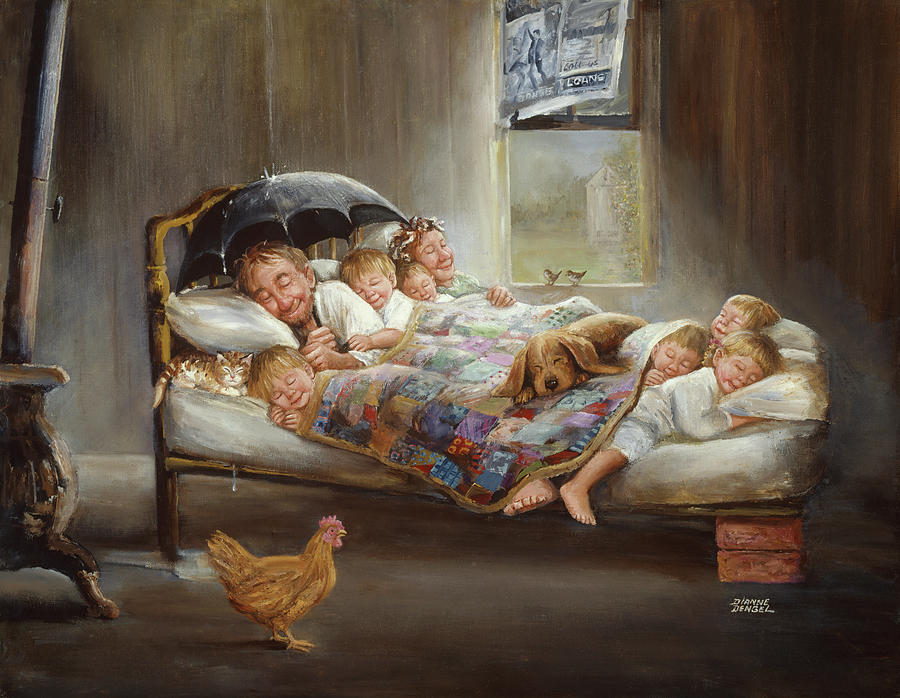
A patched quilt, children, a dog, a cat, an umbrella – water drips from the roof but everyone is smiling. In the lower right corner, a signature: Dianne Dengel. The painting is called "Home Sweet Home," its creator an American woman who appeared on Mr. Rogers' Neighborhood, known for her "art that makes you smile" philosophy – from rural Pennsylvania, from the warm side of naïve art.
The real story is not in the painting but in a question – and in what happened to that question.
1930Two grandsons of pashas
Istanbul, early 1930s, the editorial office of the Yarın newspaper. One is proofreading, the other drawing cartoons – one the grandson of Mustafa Celalettin Pasha, Nazım Hikmet, the other the grandson of Governor Abidin Pasha, Abidin Dino. Eleven years separate them: Nazım is twenty-eight, Abidin seventeen. Both from the last generation of Ottoman aristocracy, both cut loose from that world, both searching for what to put in its place.
Nazım had seen the futurist and constructivist painters in Moscow – Mayakovsky's posters, El Lissitzky's book designs, that world where the word became visual force. He recognised a similar energy in Abidin's drawings: the line was not decoration but a tool for thought. They met.
1931–1939A word, a line
When Sesini Kaybeden Şehir came out in 1931, the cover design and interior illustrations were Abidin's – the first book Nazım and Abidin made together, one of Abidin's first book designs. In 1932 came Bir Ölü Evi, then the illustrations for Kuvâyı Milliye Destanı. The division of labour formed on its own: Nazım found the word, Abidin its visual counterpart; between them there was neither patronage nor apprenticeship – two men speaking in different languages yet saying the same thing, each the other's translator.
1938–1950Both sides of the wall
In 1938 Nazım entered Bursa Prison and could not leave for twelve years. During that time Turkey skirted the edge of the Second World War and took its first steps toward multiparty politics, while Nazım sat in the same cell looking out at the same courtyard.
Abidin was among the regular visitors – he carried paper, paint, news. When Nazım began a hunger strike, Abidin and Orhan Veli organised a petition campaign, trying to build outside pressure. When Nazım was finally released, he stayed for a while at Abidin's house in Caddebostan – the first stop for the man leaving prison was the home of the friend who had visited him for years.
For twelve years one wrote inside, the other drew outside; the wall came between them, but the bond did not.
1951–1952The geography of exile
In 1951 Nazım left Istanbul on a motorboat – at night, across the Black Sea, leaving his citizenship and his right of return behind to seek refuge in Moscow. A year later Abidin left too, but in a different direction: he settled in Paris with his wife Güzin Dino. They were no longer even in the same country – one east of the Iron Curtain, the other west, with only letters passing between them.
Abidin continued translating Nazım's poems into French and publishing them in journals, continued illustrating his books. Exile could not sever the friendship but changed its form: they were no longer two men sitting side by side and talking, but two exiles following each other's voice on paper. They lived through the same seasons in different cities – while Moscow's snow fell, Paris's chestnuts dropped, but both their windows looked onto another country.
1961The Seine, at night
In 1961 Nazım came to Paris – to visit Abidin and Güzin, perhaps to see them one last time; whether he thought of it consciously we cannot know, but the texture of the poem says so. In an attic hotel room overlooking the Seine, at night, he began writing a long poem dedicated to his wife Vera Tulyakova: Saman Sarısı – Straw Yellow.
It was the poem of a man approaching sixty, two heart attacks behind him, knowing he would never return to his country – like a note written on the last page while closing the ledger of a life. He would die two years later. In the middle of the poem, he turned directly to his friend of thirty years:
Without taking the easy way out, though –
not the angel-faced mother nursing her rosy-cheeked baby,
nor the apples on a white cloth,
nor the red fish drifting among bubbles in an aquarium.
Could you paint the picture of happiness, Abidin? Nazım Hikmet – Saman Sarısı (Straw Yellow), 1961
Note the structure: Nazım first lists false happinesses one by one – postcard images, calendar pictures, framed sweetness – and rejects them all with the condition "without taking the easy way out." Then he repeats the same question. But the repetition is not emphasis; it is a vice: where the first question asks "could you," the second asks "now that you have seen what it is not, what is left?" What is left is the question itself – unanswered, open, honest.
The letter with no answer
Abidin did not answer – not with a painting, not with a poem, not even with a direct word. In interviews, when he came close to the subject, he said that happiness requires continuity, that he could capture on canvas the joy of a moment but permanent happiness was beyond representation; the painter's brush can seize movement, a moment, a cross-section of feeling, but happiness is not a cross-section – it is a process, something that keeps flowing, and the instant you freeze what flows, you kill it.
This silence was perhaps the most honest response the question could receive. Nazım had not expected an answer – he had asked because he knew his friend's limits, asked in order to show the limit itself. Abidin too knew the limit, and so he was silent. Two masters stood before the same wall; one said "you cannot cross," the other nodded.
3 June 1963
Nazım Hikmet died of a heart attack near Moscow, in Peredelkino; he was sixty-one. The question remained in the air – but Nazım had never asked it expecting an answer.
Abidin lived another thirty years after his friend's death. During those thirty years he continued illustrating Nazım's work, promoting it, attending memorial events – but he never painted "the picture of happiness."
7 December 1993
Abidin Dino died in Paris at the age of eighty; his body was brought to Istanbul. For thirty years he had not answered the question – a deliberate silence, a confirmation of the truth articulated in the question.
A borrowed voice
Abidin was silent, but others could not be. In 1987, at an exhibition in Essen, a poet named Bahattin Gemici met Abidin Dino – and the encounter must have impressed him enough that he wrote a poem in Dino's voice, addressed to Nazım: "Mutluluğun Resmi." The poem was published in 1988 in his book Yarım Bırakma Türkünü. We do not know how Gemici came to know the story, or whether he asked Dino's permission – the book offers no explanation.
to the place where we first met,
and you would drink my bitter coffee.
If we could talk
of those days, of the past, of the future –
what days would pass,
what nights…
That is when, Nazım,
I would paint the picture of happiness –
but no canvas would suffice for that;
no paint… Bahattin Gemici – Yarım Bırakma Türkünü, 1988
A sincere poem – but not Abidin's poem. Gemici borrowed Dino's voice, with deference and good will, but borrowed all the same. The internet spread it without knowing the difference: it began circulating as "Abidin Dino's answer to Nazım"; those who shared it did not check the source, those it was shared with did not check either, and each repetition seemed to confirm the one before.
Then someone added Dengel's painting and a perfect package emerged: Nazım had asked the question, Abidin had answered, and Abidin had painted the picture – everything seemed to fall into place. In this package combining a question, a poem, a painting, and two names, there was only one genuine piece: Nazım's question. The answer was Gemici's, the painting was Dengel's, and Abidin's contribution was the one thing absent from the package – silence.
The sentence behind the question mark
"Could you paint the picture of happiness?" – the question mark at the end of this sentence is a rhetorical mark, the exclamation of impossibility. Nazım was not expecting an answer; he was stating a truth.
Nazım knew everything Abidin could do – for years he had had him design book covers, had watched his line, his colour, what he caught and what he missed, from close range. But he was saying: with all your power, you cannot paint happiness. This was not a challenge but a recognition of limits made with love and respect – he was not telling his painter friend "you are insufficient" but "none of us suffices."
In Turkish poetry this structure forms a deep vein. A glance at Orhan Veli's lines is enough:
in these lines;
could you touch
my tears, with your hands? Orhan Veli Kanık
Would you hear means you would not, could you touch means you could not. The poet knows the power of his lines but also knows he cannot carry you all the way there; he can bring you close, lead you to the threshold, and there he will stop. Nazım stood on the same threshold: art is the act of approaching what cannot quite be reached, to keep drawing, writing, speaking while standing at that border – and to accept staying on this side while trying to show the other.
The open they wanted closed
The internet took the question and turned it into a puzzle – it saw an open question as a deficiency that needed closing. Someone found Dengel's painting – water dripping from the roof, the family huddled together – said "this is happiness" and shared it as "a work by Abidin Dino"; it has been circulating uncorrected for years, because correcting is not as easy as sharing.
People who could not bear the power of the question felt the need to close it. An unanswered question was disturbing – they solved it like a maths problem, found the unknown, closed the equation. Without realising it, they proved Nazım's claim that it cannot be painted: what they thought they had painted was someone else's painting; the answer they thought they had given was someone else's poem. The real answer was Abidin's silence, and that silence fit into no package.
Nazım did not ask a question; he said something. Abidin heard it and stayed silent – because it was true.
Then others came: one wrote a poem in Dino's voice, another pasted in an American painter's work, everyone said "here is the answer." But for more than sixty years the most honest response remains Abidin's silence – because some questions are not questions, and some silences say more than anything that could be said.
OTHER WRITINGS
Hallucination: Whose Problem? · On Hatred · Research Constitution · Exactly · Tea Table · Sturgeon's Law · From Text to Voice · Understanding